Plotter blades geometry |
GIS Premium Blades |
||
Angles, offset, overcut |
|||
Wedge angle? |
Clearance angle? |
Cutting edge angle? |
Offset? |
Orthogonal to
cutting direction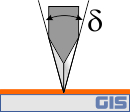 |
Cutting direction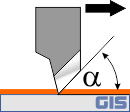 |
Cutting direction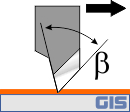 |
Cutting direction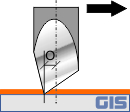 |
| The angle across the cutting edge measured at the point of the tip. | The angle between the foil surface and the
cutting edge. |
The angle between the front and rear edge of the blade. | The distance by which the blade's tip follows the symmetry line (for drag blades only). |
| Usually applies: α + β = 90°. With
double-sided blades, the cutting edge angle is measured from edge to
edge. |
|||
Overcut |
||
 |
 |
|
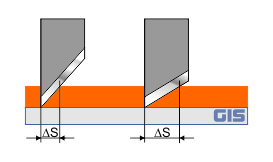
| The overcut is the measure between the symmetry
line of the blade and the intersection point of the cutting edge
with the material surface. The overcut slightly alters contours on
curves, but in practice this is usually insignificant. The deformation can be reduced by selecting blades with a steep clearance angle α . It is not possible to cut completely without any overcut, the blade would then have to be "infinitely steep". |
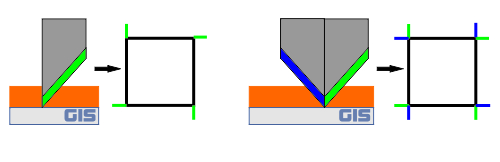
A single-sided plotter blade creates an overcut only to the front. | A double-sided plotter blade creates an overcut
to the front and back. This is usually helpful for weeding, but can be unfavorable for filigree motifs or for repro work with masking film ("sparks"). |
|
GIS Gienger Industrie-Service GmbH
• Max-Eyth-Str. 14 • D - 78194 Immendingen Tel. +49-(0)7461-1620 20 • Fax. +49-(0)7461-1620 21 •  mail: info@gis-tec.com
•
web: www.gis-tec.com
mail: info@gis-tec.com
•
web: www.gis-tec.com |
||
|
IMPRINT / DISCLAIMER |
PRIVACY NOTICE |